
Axelspace GRUS Satellites | High-Resolution Earth Observation Constellation
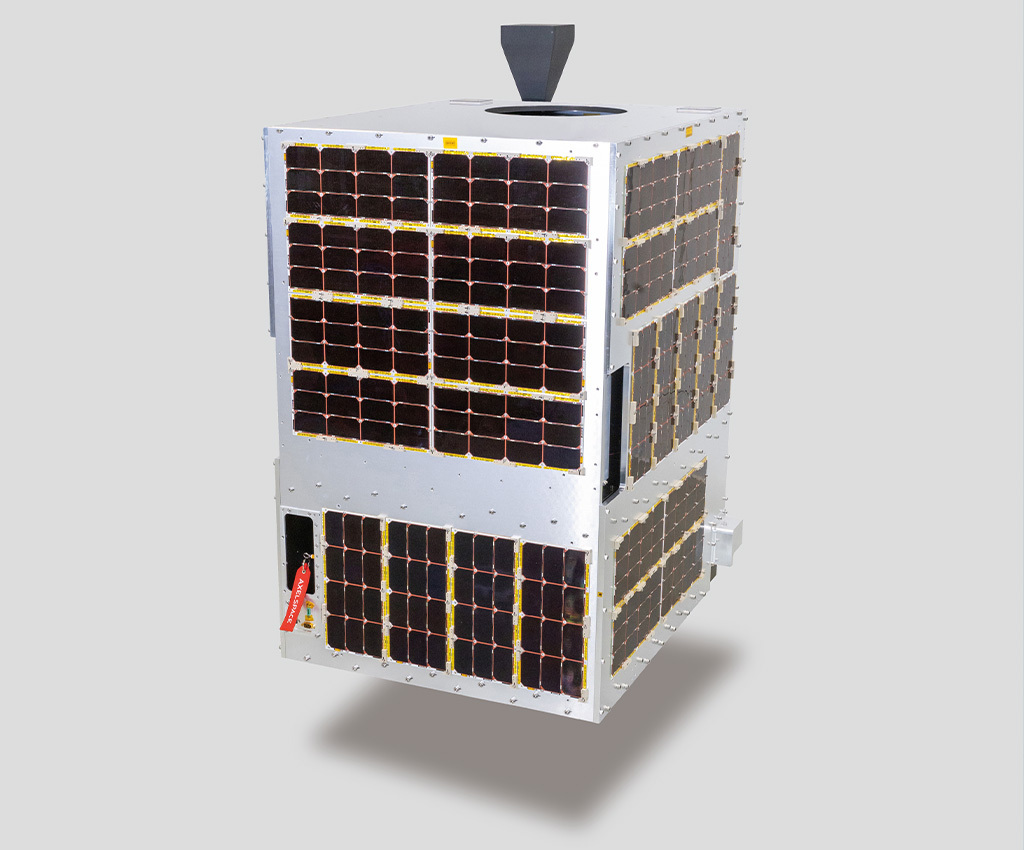
GRUS-3 | Image Credit: Axelspace
SATPALDA provides high-frequency, high-resolution optical imagery from the Axelspace GRUS microsatellite constellation, including the newly added GRUS-3 series. Operating in Sun-Synchronous Orbit (SSO), this fleet delivers cost-effective 2.2-meter resolution satellite data to support geospatial mapping, environmental monitoring, maritime analytics, and urban planning across India and globally.
Overview & Platform Capabilities
GRUS is an optical microsatellite constellation developed by Axelspace Corporation. Designed for high-revisit Earth observation, each satellite operates at a compact mass of approximately 100 kg while providing wide swath coverage and high spatial resolution.
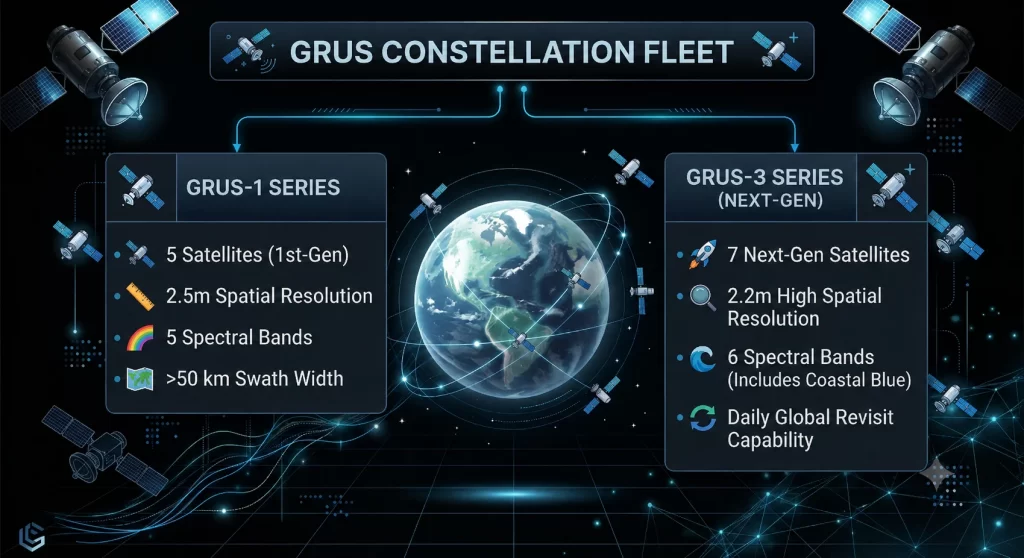
With the successful orbit deployment of seven GRUS-3 microsatellites, the active fleet has grown to 12 operational satellites. Operating via the AxelGlobe platform and distributed by Satpalda, the constellation provides rapid global revisit times, significantly reducing imagery acquisition cycles and offering consistent, fresh geospatial data for critical decision-making.
Technical Specifications of GRUS Constellation
The table below outlines the core specifications and sensor capabilities across the GRUS fleet:
| Feature / Metric | GRUS-1 Constellation (1A–1E) | GRUS-3 Constellation (Next-Gen) |
|---|---|---|
| Active Fleet Size | 5 Satellites | 7 Satellites |
| Spatial Resolution (GSD) | 2.5 meters (Panchromatic) / 5.0 meters (Multispectral) | 2.2 meters |
| Spectral Bands | Panchromatic, Blue, Green, Red, Red-Edge, NIR | Panchromatic, Coastal Blue, Blue, Green, Red, Red-Edge, NIR |
| Swath Width | > 50 km | 28.3 km (Max capture length: 1,356 km) |
| Orbital Altitude | 550 km (SSO) | 585 km (SSO) |
| Launch Vehicle | Soyuz-2 | SpaceX Falcon 9 |
| Commercial Status | Fully Operational | Fully Operational |
Launch & Mission Details
GRUS-1A
Launch Date: December 27, 2018 – 02:07 UTC
Launch Vehicle: Soyuz-2
Current Status: Operational
GRUS-1B, 1C, 1D, 1E
Launch Date: March 22, 2021 – 06:07 UTC
Launch Vehicle: Soyuz-2
Current Status: Operational
GRUS-3 (7 Satellites)
Launch Date: July 7, 2026 – 07:12 UTC
Launch Vehicle: SpaceX Falcon 9
Current Status: Operational / First Images Released
GRUS-3 First Images & Sample Satellite Data
The newly deployed GRUS-3 microsatellites demonstrate superior optical quality and spectral precision, capturing high-detail imagery across diverse global terrain types.
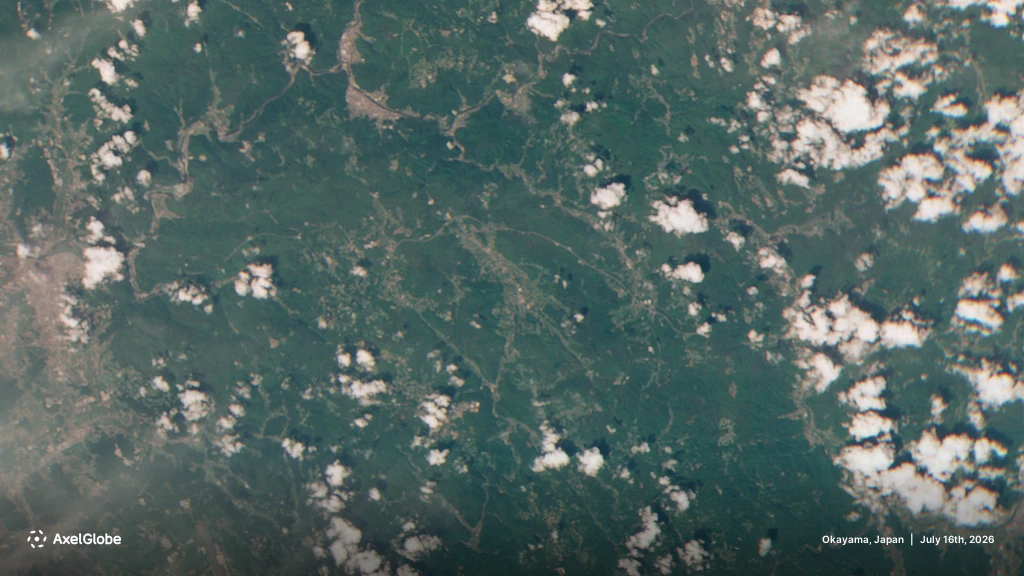
GRUS-3 | Image Credit: Axelspace
Advanced Imaging Capabilities & Sensor Benefits
- Dedicated Coastal Blue Band: GRUS-3 introduces a specialized Coastal Blue spectral band (400–450 nm). This sensor capability enhances shallow-water bathymetry, coastal water quality assessment, aquatic vegetation monitoring, and marine ecosystem analysis.
- Enhanced Spatial Resolution: The upgraded 2.2-meter Ground Sample Distance (GSD) delivers sharper visual clarity for infrastructure tracking, precision agriculture, and land-use mapping.
- Near-Daily Global Revisit: With 12 active satellites in orbit, locations north of 25° latitude can be imaged on a daily basis, facilitating rapid change detection and emergency disaster response.
- Large-Area Earth Coverage: The expanded constellation provides a combined daily capture capacity exceeding 2.3 million km², enabling uninterrupted regional surveys without spectral variation.
FAQ's
What is the spatial resolution of Axelspace GRUS satellite imagery?
- GRUS-1 (First Generation): 2.5 metres
- GRUS-3 (Next Generation): 2.2 metres
Which spectral bands are available in GRUS-3 imagery?
- Panchromatic
- Coastal Blue
- Blue
- Green
- Red
- Red Edge
- Near-Infrared (NIR)
How can I order or task GRUS satellite data in India?
You can order archive imagery or request new satellite tasking directly through SATPALDA, an official partner for Axelspace GRUS satellite data.