Satellite-Based Solar Panel Detection Using Machine Learning
Bhadla Solar Park, Rajasthan, India
True Color Composite (TCC)
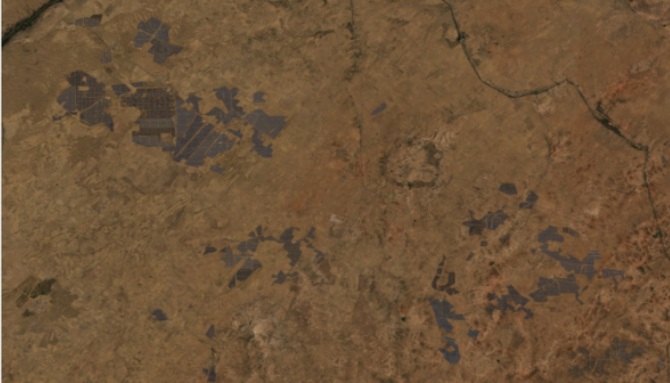
Figure 1: Bhadla Solar Park, Rajasthan, India
The rapid expansion of large-scale solar power plants requires efficient and reliable monitoring techniques. Remote sensing combined with Artificial Intelligence and Machine Learning (AI/ML) offers a scalable solution for mapping and monitoring solar infrastructure over vast areas. This study focuses on detecting solar panels using satellite imagery over Bhadla Solar Park in Rajasthan, India, the world’s largest solar power plant.
Data Used: Sentinel-2
Spatial Resolution: 10 meters
Area of Interest: Bhadla Solar Park, Rajasthan, India
Methodology:
- Sentinel-2 surface reflectance imagery was used as the primary data source for
solar panel detection. - Basic preprocessing and band preparation were carried out before feature
generation. - All Sentinel-2 bands and the derived indices were stacked to form the final feature set.
- Training samples for solar panels and non-solar classes were collected from the study area.
- A Random Forest classifier was trained using the stacked features and the training samples.
- The trained model was applied to the full image to generate the solar panel detection map.
The following spectral indices were computed to enhance the separability of solar panels:
| S. No. | Spectral Indices Used | Reason |
|---|---|---|
1 | NDVI (Normalized Difference Vegetation | Used to remove vegetated areas from
analysis. |
2 | NDBI (Normalized Difference Built-up | Used to highlight built-up and man-made |
3 | Simple Ratio (NIR / Red) | Helps capture the spectral response of |
4 | Visible Brightness Index (Blue, Green and | Represents the generally low reflectance
of solar panels in the visible spectrum. |
Outcome:
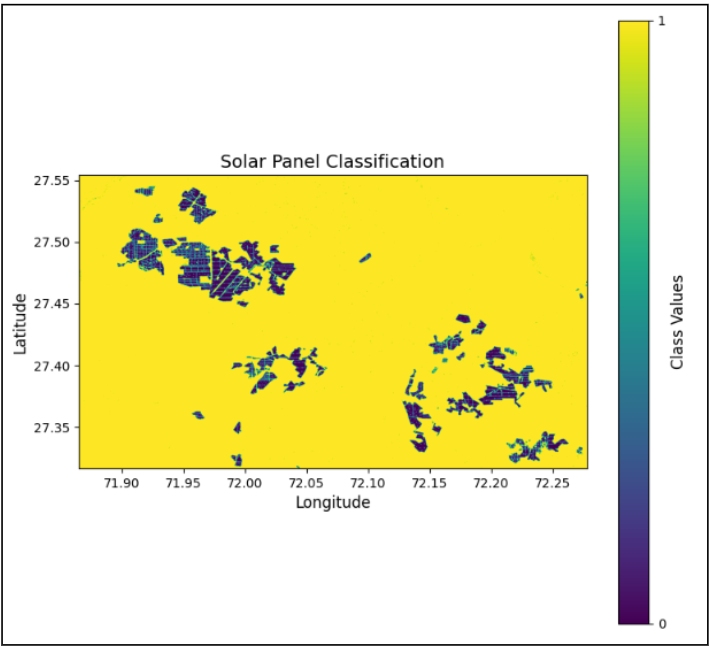
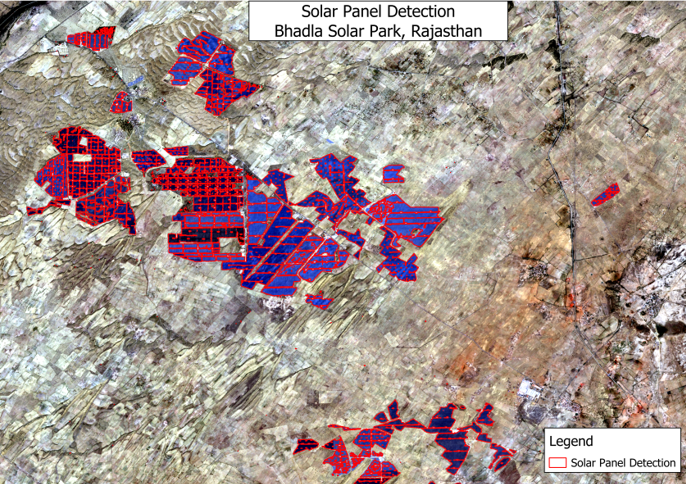
Result:
- Overall model accuracy achieved: 91%.
- Model successfully identified solar panel installations across Bhadla Solar Park.
- Clear separation of solar panels from barren land and other non-solar surfaces.
- Useful for monitoring solar park expansion and renewable energy assessment.
Amit Thakur
GIS Engineer