
Urban Planning & Smart Cities
Building Smarter Cities with Geospatial Intelligence
Satellite imagery provides a real-time, comprehensive view of the Earth’s surface. Satpalda delivers precise, actionable data that helps governments, enterprises, and researchers make informed decisions in urban planning, defense, agriculture, and environmental monitoring.
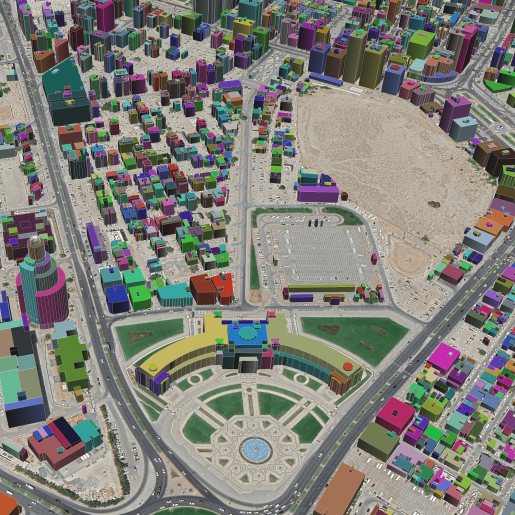
Transforming Cities with Satellite Imagery & GIS Intelligence
From high-resolution base mapping to disaster resilience planning, our geospatial solutions enable sustainable urban growth and smarter infrastructure decisions.
High-Resolution Urban Base Mapping
High-resolution satellite imagery and GIS mapping enable precise urban base maps for roads, buildings, utilities, and land use land cover (LULC). Accurate geospatial data supports master planning, zoning regulations, infrastructure development, and smart city initiatives. With advanced remote sensing and digital elevation models (DEM), planners gain reliable spatial intelligence for sustainable urban growth. Detailed base mapping improves decision-making, reduces planning errors, and enhances coordination between government agencies, civil engineers, and urban development authorities.
3D City Models and Digital Twins
Advanced 3D city models and digital twins powered by satellite imagery, LiDAR, and photogrammetry provide immersive visualization of urban environments. These geospatial solutions support smart city planning, infrastructure simulation, mobility analysis, and energy optimization. Accurate 3D modeling enables better building height assessment, shadow analysis, and urban density planning. By integrating GIS dashboards with real-time spatial data, city administrators can improve governance, infrastructure lifecycle management, and long-term urban resilience strategies.
Infrastructure Progress Monitoring
Multi-temporal satellite imagery and remote sensing technology enable accurate infrastructure progress monitoring across highways, metro projects, airports, and industrial corridors. Time-series geospatial data tracks construction stages, identifies delays, and detects encroachments in near real-time. GIS-based analysis ensures transparency, compliance, and efficient project management. High-resolution earth observation data helps stakeholders assess site conditions, measure land deformation, and optimize resource allocation for faster and cost-effective infrastructure development.
Integrated GIS-Based Dashboards
Integrated GIS-based dashboards centralize satellite imagery, spatial analytics, and infrastructure data into a single decision-support platform. These web GIS systems enable real-time monitoring, urban governance, asset tracking, and performance analytics. By combining geospatial intelligence with administrative datasets, authorities can enhance public service delivery, land management, and infrastructure planning. Cloud-based GIS dashboards improve collaboration, transparency, and data-driven policymaking for municipalities, smart cities, and government agencies.
Urban Growth and Sprawl Analysis
Satellite imagery and time-series remote sensing data enable comprehensive urban growth and sprawl analysis. GIS-based land use land cover classification identifies built-up expansion, informal settlements, and environmental impact zones. Urban planners can monitor land use change, infrastructure pressure, and population-driven development patterns. Geospatial analytics help authorities implement sustainable zoning policies, control unplanned expansion, and support climate-resilient urban planning through accurate spatial intelligence.
Transportation and Mobility Planning
Geospatial technology and satellite imagery support advanced transportation and mobility planning. GIS mapping enables road network analysis, traffic flow modeling, route optimization, and public transport planning. High-resolution spatial data helps identify congestion hotspots, infrastructure gaps, and urban accessibility challenges. Integrated remote sensing and spatial analytics improve corridor planning, transit-oriented development, and smart mobility initiatives, ensuring efficient, safe, and sustainable transportation systems.
Utility and Asset Management
GIS-based utility mapping and satellite imagery improve asset management for water supply, sewer networks, power grids, and telecom infrastructure. Accurate geospatial data ensures better maintenance planning, leakage detection, and infrastructure lifecycle monitoring. Digital surface models (DSM) and spatial analytics enhance network design and risk assessment. By integrating web GIS dashboards, municipalities and utility providers can optimize operations, reduce downtime, and improve service delivery through data-driven infrastructure management.
Disaster Risk and Resilience Planning
Satellite imagery and remote sensing play a critical role in urban disaster risk assessment and climate resilience planning. GIS-based flood modeling, heat island mapping, and vulnerability analysis support proactive mitigation strategies. Time-series spatial data helps monitor land subsidence, drainage patterns, and environmental change. Geospatial intelligence enables governments and planners to design resilient infrastructure, reduce disaster impact, and strengthen sustainable urban development policies.