Archive vs. Tasking: How to Choose the Right Satellite Imagery
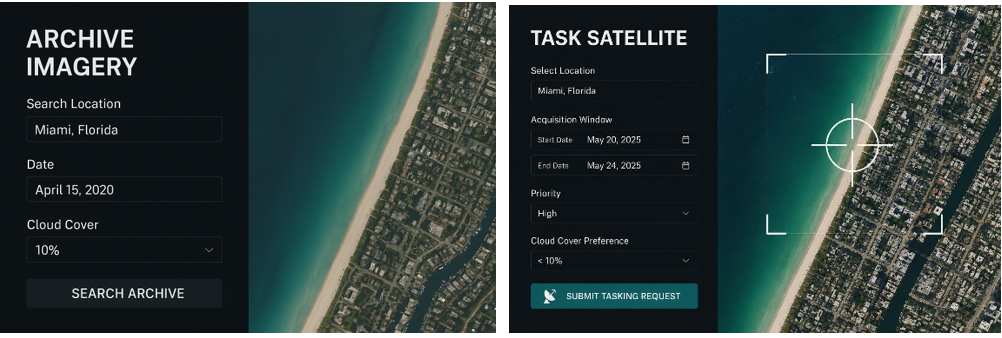
Archive imagery vs satellite tasking visual comparison showing historical data library and targeted satellite capture
Satellite imagery procurement is one of the most important decisions in any geospatial, engineering, environmental, or intelligence-driven project. Organisations today can either access previously collected imagery from large satellite archives or request a satellite operator to capture entirely new imagery through a process known as satellite tasking.
Understanding the difference between archive imagery and tasking imagery is essential for selecting the most cost-effective and operationally suitable solution.
The choice between archive imagery and satellite tasking depends primarily on your timeline, budget, and data requirements.
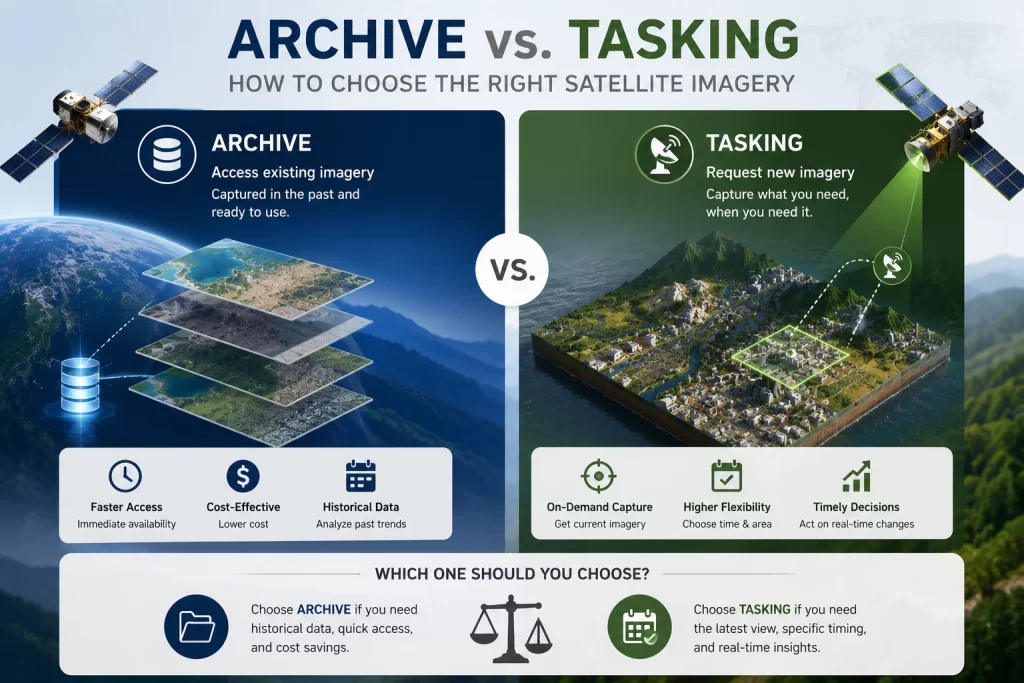
Archive imagery provides immediate access to previously captured satellite data at a lower cost, making it ideal for historical analysis, baseline creation, and change detection studies.
Satellite tasking, on the other hand, involves scheduling a satellite to capture a new image of a specific location in the future, enabling access to the most recent and customised ground conditions for time-sensitive operations.
Satellite imagery procurement is one of the most important decisions in any geospatial, engineering, environmental, or intelligence-driven project. Organisations today can either access previously collected imagery from large satellite archives or request a satellite operator to capture entirely new imagery through a process known as satellite tasking.
Understanding the difference between archive imagery and tasking imagery is essential for selecting the most cost-effective and operationally suitable solution.
The choice between archive imagery and satellite tasking depends primarily on your timeline, budget, and data requirements.
Archive imagery provides immediate access to previously captured satellite data at a lower cost, making it ideal for historical analysis, baseline creation, and change detection studies.
Satellite tasking, on the other hand, involves scheduling a satellite to capture a new image of a specific location in the future, enabling access to the most recent and customised ground conditions for time-sensitive operations
Common Use Cases for Archive Imagery
- Environmental Change Detection
Archive imagery is widely used for analyzing long-term environmental and land-cover changes such as deforestation, coastal erosion, urban expansion, glacier retreat, and land-use transformation by comparing historical satellite datasets over time.
- Historical Site Analysis
Organizations use archived satellite data to study previous site conditions, development patterns, and terrain evolution before initiating infrastructure, urban planning, mining, or engineering projects.
- Baseline Mapping
Archive imagery provides reliable pre-event and pre-construction baseline conditions for environmental impact assessments, infrastructure planning, feasibility studies, and regional geospatial analysis.
- Agriculture Monitoring
Historical imagery supports agricultural trend analysis by enabling monitoring of crop cycles, irrigation changes, vegetation health, and drought impacts across multiple growing seasons.
- Disaster Comparison Studies
Pre-disaster archive imagery is essential for comparing conditions before and after floods, earthquakes, storms, or wildfires, helping authorities assess damage extent and recovery progress.
Advantages of Archive Imagery
- Cost-effective
- Fast delivery
- Extensive historical coverage
- Suitable for large-area studies
- Easy scalability for regional analysis
Limitations of Archive Imagery
- Data may not be recent enough
- Cloud cover may affect usability
- Limited acquisition angle options
- Restricted to existing captures
Satellite Tasking: Custom Eyes on the Ground
Satellite tasking is the process of requesting a satellite operator to capture a new image of a specific geographic location during a future satellite pass.
Instead of relying on previously collected imagery, users essentially instruct the satellite to acquire fresh data tailored to project requirements.
Tasking is critical when the latest ground conditions are required or when archive imagery does not meet quality, timing, or cloud-cover requirements.
Key Characteristics of Satellite Tasking
- Newly acquired custom imagery
- Most current ground conditions
- Higher operational flexibility
- Ability to define acquisition parameters
- Priority-based collection scheduling
- Better control over cloud-free acquisition opportunities
Common Use Cases for Satellite Tasking
- Construction Monitoring
Satellite tasking enables continuous monitoring of construction activities, earthworks, road development, utility installation, and infrastructure progress by capturing the latest site conditions at scheduled intervals.
- Emergency Response
Tasked imagery provides rapid situational awareness during floods, earthquakes, wildfires, cyclones, and industrial disasters by delivering current ground conditions for emergency assessment and response planning.
- Defence and Security
Satellite tasking supports surveillance, border monitoring, tactical intelligence, and operational planning where timely and high-priority geospatial intelligence is critical.
- Competitive Intelligence
Organisations use tasked imagery to monitor industrial activity, mining operations, logistics infrastructure, ports, and commercial development projects requiring up-to-date observations.
- Time-Sensitive Surveys
Tasking is ideal for projects that require imagery from specific dates, seasons, or operational windows, ensuring data acquisition aligns precisely with project timelines and environmental conditions.
Advantages of Satellite Tasking
- Access to the newest imagery available
- Custom acquisition scheduling
- Greater mission flexibility
- Improved cloud management options
- High operational relevance
Limitations of Satellite Tasking
- Higher cost
- Potential scheduling delays
- Weather dependency
- Satellite revisit constraints
- Longer delivery timelines
| Feature | Archive Imagery | Satellite Tasking |
|---|---|---|
Availability | Readily Available datasets | Scheduled Future Acquisition |
Data Type | Historical Imagery | Newly Captured Imagery |
Cost | Budget-Friendly | Premium Pricing |
Customization | Limited to Existing Data | High Customization |
Acquisition Control | None | User-Specified Parameters |
Cloud Management | Limited | Better Opportunity Planning |
Best For | Historical Analysis & Change Detection | Current Monitoring & Surveys |
Operational Flexibility | Moderate | High |
Geographic Coverage | Extensive Archives | Targeted Areas |
When to Use Archive Imagery
Archive imagery is the best choice when:
- Historical analysis is required
- Budget efficiency is important
- Large areas must be analyzed
- Temporal trend studies are involved
- Historical baseline conditions are sufficient
When to Use Satellite Tasking
Satellite tasking becomes necessary when:
- The latest ground conditions are critical
- Historical imagery is outdated
- Cloud-free acquisition is required
- Active operations must be monitored
- High-priority intelligence is needed
When to Use a Hybrid Approach
Many organizations combine both archive imagery and satellite tasking to maximize operational efficiency and analytical depth.
A common workflow involves:
- Using archive imagery to study historical site conditions and long-term trends.
- Initiating satellite tasking for ongoing monitoring once project activities begin.
Conclusion
Both archive imagery and satellite tasking serve critical but distinct roles in modern Earth observation workflows. Choosing the right approach depends on balancing project urgency, historical requirements, budget constraints, and operational objectives. In many cases, combining both solutions delivers the most comprehensive and effective geospatial intelligence strategy.
Sanchita Maitri
GIS Engineer