GIS vs GPS: Key Differences and How They Work Together
The terms GIS and GPS are often used interchangeably, especially by people who are new to geospatial technology. While both technologies deal with location and geographic information, they serve very different purposes. In fact, one of the most common misconceptions in the geospatial industry is assuming that GIS and GPS are the same thing. Understanding the relationship between the two is essential for anyone working with mapping, surveying, urban planning, infrastructure management, agriculture, or Earth observation data.
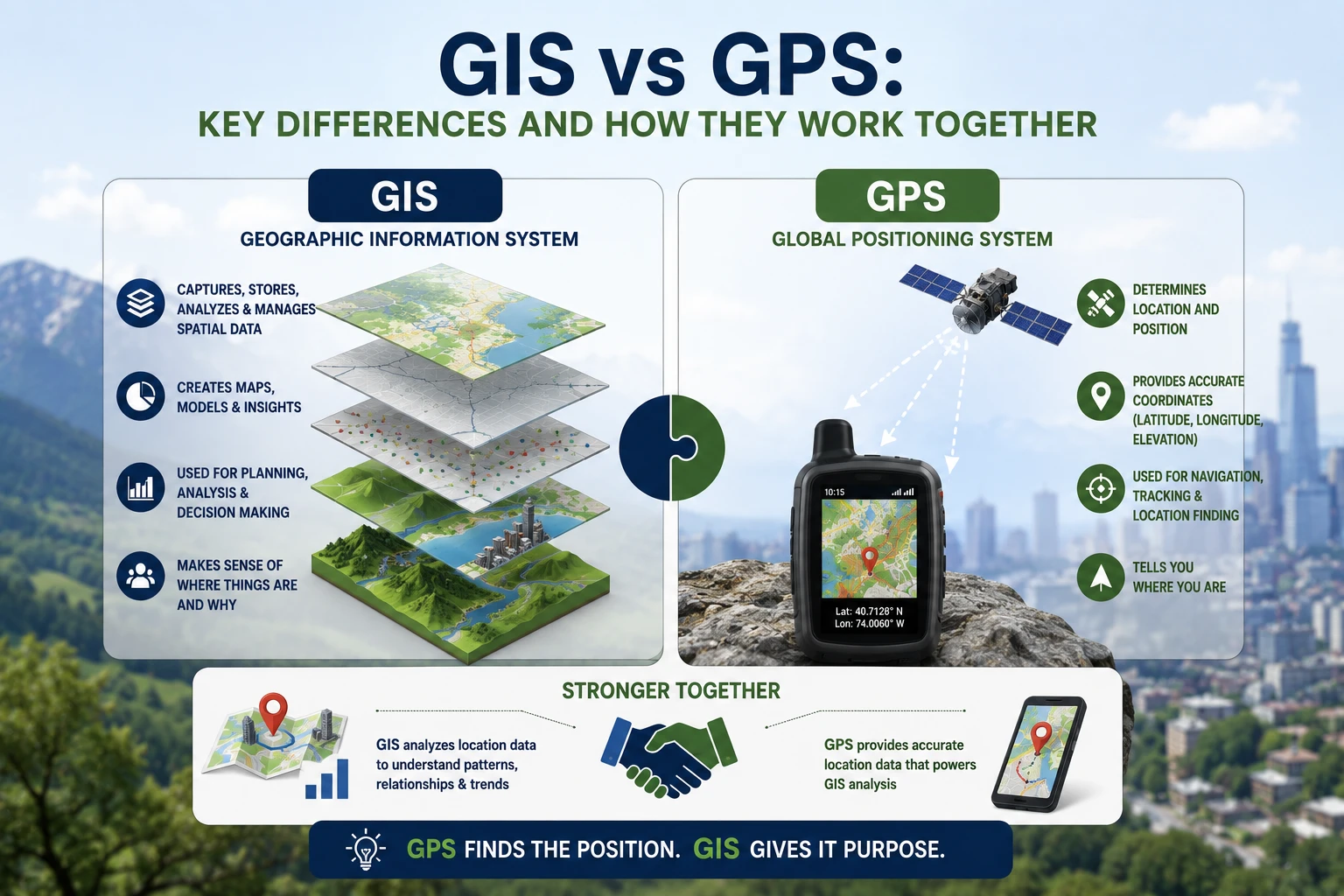
When discussing GIS vs GPS, it is helpful to think of GPS as a tool for collecting location information, while GIS is a system for storing, analyzing, and visualizing that information. GPS tells you where something is. GIS helps you understand what that location means and how it relates to other geographic features.
Today, organizations across industries use both technologies together to create powerful location intelligence solutions. From navigation systems and asset tracking to disaster management and smart city planning, GIS and GPS form the foundation of modern geospatial operations.
Understanding the Difference Between GIS and GPS
To understand the difference between GIS and GPS, it is important to first define each technology separately.
GPS, or Global Positioning System, is a satellite-based navigation system that determines the precise location of a receiver anywhere on Earth. Developed originally for military applications, GPS has become a fundamental technology used in smartphones, vehicles, surveying equipment, drones, and countless other devices. It works by receiving signals from a network of satellites orbiting the planet and calculating position through a process known as trilateration.
GIS, or Geographic Information System, is a much broader technology framework. Rather than simply identifying locations, GIS collects, manages, analyzes, and visualizes spatial data. It combines geographic coordinates with descriptive information to reveal patterns, trends, and relationships that support decision-making.
Consider a utility company maintaining thousands of electrical assets. GPS can be used by field technicians to capture the exact location of power poles, transformers, and substations. Once collected, that data is imported into a GIS platform where managers can analyze maintenance schedules, assess service coverage, identify risk areas, and optimize operations.
This example highlights a fundamental concept: GPS gathers location data, while GIS transforms that data into actionable intelligence.
How GPS Works and Why It Matters
GPS is one of the most widely used technologies in the modern world, yet many people are unaware of how it actually works.
The Global Positioning System relies on a constellation of satellites continuously transmitting signals toward Earth. GPS receivers calculate their position by measuring the travel time of these signals from multiple satellites. By communicating with at least four satellites simultaneously, a receiver can determine its exact latitude, longitude, elevation, and time.
GPS has transformed countless industries because of its ability to provide highly accurate positioning information in real time. Navigation applications use GPS to guide drivers and pedestrians. Surveyors rely on GPS to establish precise boundaries and measurements. Logistics companies use GPS to track vehicle fleets and optimize delivery routes.
In agriculture, GPS supports precision farming by enabling equipment to operate with centimeter-level accuracy. Construction firms use GPS-guided machinery to improve efficiency and reduce errors. Emergency responders depend on GPS to navigate quickly during critical situations.
Despite its importance, GPS has limitations. It primarily provides location information and does not offer deeper analytical capabilities. This is where GIS becomes essential.
How GIS Turns Geographic Data Into Intelligence
The real power of geospatial technology emerges when GPS data is integrated into a GIS environment.
A GIS platform can combine GPS coordinates with multiple layers of information, including satellite imagery, demographic data, infrastructure networks, environmental conditions, land use classifications, and real-time sensor data. This creates a comprehensive view of geographic relationships that cannot be achieved through GPS alone.
For example, a municipal government may use GPS devices to record the locations of road defects throughout a city. While GPS identifies where the defects exist, GIS enables engineers to analyze road conditions, prioritize repairs, estimate maintenance costs, and identify neighborhoods most affected by infrastructure issues.
Similarly, environmental agencies may collect GPS-based field observations during wildlife surveys. By importing those observations into GIS, researchers can identify migration patterns, habitat changes, and conservation priorities.
This capability demonstrates the key GIS and GPS difference. GPS answers the question “Where?” while GIS answers questions such as “Why here?”, “What does it mean?”, and “What should we do next?”
The analytical capabilities of GIS have made it indispensable for organizations seeking to transform geographic data into strategic insights.
How GIS and GPS Work Together in Real-World Applications
Rather than viewing GIS and GPS as competing technologies, it is more accurate to see them as complementary systems that become significantly more powerful when used together.
One of the most common applications of GIS and GPS integration is asset management. Utility companies use GPS devices to collect the locations of infrastructure assets, while GIS platforms manage and analyze those assets throughout their lifecycle.
In disaster management, emergency teams use GPS-enabled devices to collect field information during floods, earthquakes, or wildfires. GIS then combines this information with satellite imagery, hazard maps, population data, and transportation networks to support emergency response efforts.
Agriculture provides another excellent example. Farmers use GPS-guided machinery to ensure accurate planting and harvesting operations. GIS systems analyze soil data, crop health indicators, weather conditions, and historical yield information to optimize productivity and resource allocation.
Smart cities increasingly depend on GIS and GPS integration to improve transportation systems, public services, infrastructure management, and environmental monitoring. Real-time GPS data collected from vehicles, sensors, and mobile devices feeds directly into GIS platforms that help city officials make informed decisions.
These examples demonstrate why the debate around gps and gis difference should focus less on comparison and more on collaboration. The greatest value emerges when both technologies are deployed together.
Conclusion
Understanding GIS vs GPS is essential for anyone working with geographic information, mapping, or location-based technologies. While GPS provides accurate positioning and navigation capabilities, GIS delivers the analytical tools needed to interpret and understand geographic data in context.
The difference between GIS and GPS lies in their purpose. GPS determines where something is located, while GIS helps organizations analyze those locations and make better decisions. Together, they form a powerful geospatial ecosystem that supports applications ranging from infrastructure management and agriculture to disaster response and urban planning.
As the demand for location intelligence continues to grow, organizations that effectively combine GIS and GPS technologies will be better positioned to improve efficiency, reduce costs, and make smarter, data-driven decisions.
The main difference between GIS and GPS is that GPS is used to determine precise geographic locations, while GIS is used to store, analyze, manage, and visualize geographic information for decision-making.
Yes. GIS can use data from various sources, including satellite imagery, aerial photography, surveys, and existing databases. However, GPS often provides highly accurate location data that enhances GIS analysis.
GIS and GPS complement each other. GPS collects location data in the field, while GIS processes and analyzes that information to generate insights and support decision-making.
GPS is not a component of GIS, but it is one of the most common data collection technologies used within GIS workflows.
Industries including agriculture, utilities, transportation, urban planning, disaster management, environmental monitoring, defense, and infrastructure development frequently use GIS and GPS together to improve operational efficiency and decision-making.